
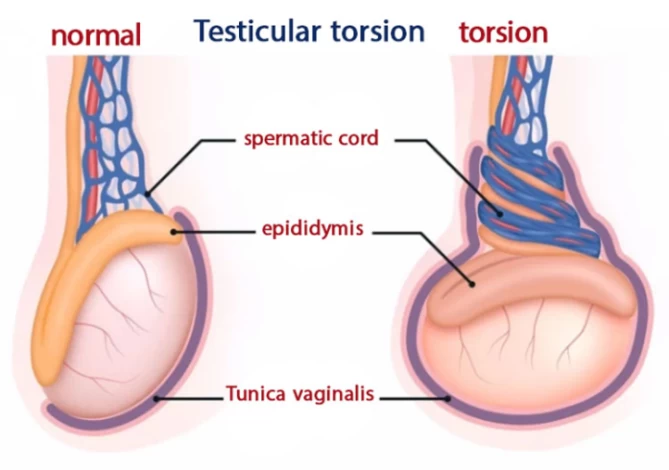
- Testicular Torsion
- What it is: A medical emergency where a testicle rotates and twists the spermatic cord, blocking vital blood flow.
- Symptoms: Sudden, severe pain and rapid swelling in the scrotum.
- Time-Sensitive Risk: Immediate medical attention is required. If the twist is not treated within a strict six-hour window, the testicle can suffer permanent damage or tissue death.
- Hydroclele
- What it is: A fluid-filled sac around the testicle that causes painless swelling or a heavy feeling in the scrotum.
- In Infants: Highly common and generally harmless.
- In Adults: Can be triggered by injury, inflammation, infections, or tumors, and requires a medical evaluation to rule out underlying causes.
- Varicocele
- What it is: Swollen, enlarged veins within the scrotum, resembling varicose veins found in legs.
- When it happens: They are highly common, generally harmless, and typically develop during puberty.
- Where it forms: They are much more frequent on the left side of the scrotum due to the natural layout of abdominal blood flow.
- Epididymitis
- What it is: Inflammation of the epididymis, the coiled tube located at the back of the testicle that stores and carries sperm.
- Primary Cause: A bacterial infection.
- Common Triggers: It most frequently develops when a sexually transmitted infection (like chlamydia or gonorrhea) or a urinary tract infection (UTI) spreads to the area.
- Inguinal Hernia
Accounting for approximately 75% of all hernias, this is the most prevalent type. It develops when tissue protrudes into the groin via a weakness or the inguinal canal in the lower abdominal wall. There is a significantly higher incidence rate in men.
- Spermatocele
- What it is: A benign (non-cancerous), fluid-filled cyst that forms in the epididymis, the coiled tube behind the testicle.
- Discovery: They are typically painless and usually found accidentally during a physical checkup.
- Treatment: No medical intervention is needed unless the cyst grows large enough to cause discomfort or pain.
- Orchitis
- What it is: Swelling and inflammation affecting one or both of the testicles.
- Bacterial Causes: Frequently develops when a urinary tract infection (UTI) or a sexually transmitted infection (STI) spreads to the tissue.
- Viral Causes: Historically and commonly linked to the mumps virus.
- Testicular Cancer
It is highly treatable and boasts an excellent cure rate. While it develops in the tissue of one or both testicles—usually starting as a painless lump or swelling—it most commonly affects younger men between the ages of 20 and 39.
Important Symptoms to Know:
- A painless lump, hard knot, or unusual swelling in a testicle.
- A new feeling of heaviness or a sudden collection of fluid in the scrotum.
- A lingering, dull ache in your lower belly or groin.
- Any pain, soreness, or general discomfort in a testicle or the scrotum.