
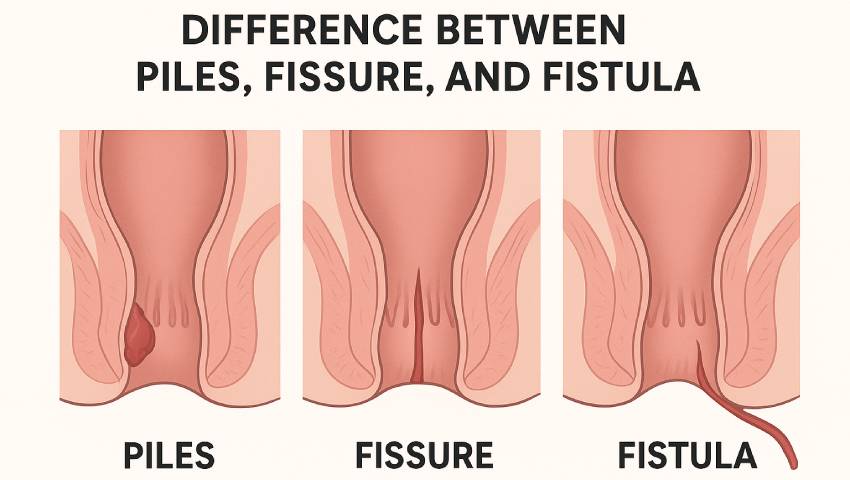
Piles, anal fissures, and anal fistulas are distinct anorectal disorders with unique characteristics, despite all causing localized discomfort. Piles involve swollen vascular tissue, fissures are physical tears, and fistulas are infected tracts.
- Anorectal Conditions At-A-Glance
| Feature | Piles (Hemorrhoids) | Anal Fissure | Anal Fistula |
| Definition | Varicose-like, inflamed veins in the lower rectum and anus. | A small laceration or crack in the anal mucosa. | An abnormal tract connecting an infected internal gland to the perianal skin. |
| Primary Triggers | Straining, chronic constipation, or pelvic pressure from pregnancy. | Trauma from hard bowel movements or severe diarrhea. | Pre-existing anal abscesses, inflammatory bowel disease, or infection. |
| Core Symptoms | Painless rectal bleeding, palpable external lumps, perianal itching. | Intense, sharp pain during/after defecation; streak of bright red blood. | Purulent or foul-smelling discharge, recurring abscesses, throbbing pain, and fever. |
| Common Care | Lifestyle changes (fiber, fluids), sitz baths, banding, or excision. | Stool softeners, topical vasodilators, or a minor sphincterotomy. | Surgical intervention is almost always necessary (fistulotomy, seton). |
Appendicitis
- What it is: Painful inflammation and infection of the appendix (a small pouch attached to the large intestine).
- The Cause: A blockage that traps bacteria, leading to rapid swelling.
- The Risk: It is a strict medical emergency. If the appendix bursts, it can spread dangerous bacteria throughout the abdominal cavity
Hernia
A hernia occurs when a tear or weakness in the connective tissue or muscle allows an internal organ to protrude. We treat following variety of Hernias:
- Inguinal Hernia
Accounting for approximately 75% of all hernias, this is the most prevalent type. It develops when tissue protrudes into the groin via a weakness or the inguinal canal in the lower abdominal wall. There is a significantly higher incidence rate in men.
- Umbilical Hernia
- What it is: A noticeable bulge near the belly button caused by tissue or the intestine pressing through the abdominal wall.
- Who it affects: It is highly common in newborn babies, but it can also form in adults, particularly those carrying excess weight.
- Incisional Hernia
- Location: Occurs at the site of a previous abdominal surgical cut.
- Cause: Tissue pushes through a weak point in the scar tissue, frequently due to poor healing of the original incision.
- Epigastric Hernia
- What it is: A bulge created when fatty tissue or part of the intestine presses through a weak spot in the upper stomach wall.
- Where it forms: Right down the middle of the abdomen, in the space between the breastbone and the navel.
- Femoral Hernia
- How it forms: Tissue presses through a weak point in the canal that carries the femoral artery into the upper thigh.
- Who it affects: They primarily occur in women.
- Risk factor: While rare, they carry a significantly higher risk of complications than other hernias.
- Spigelian Hernia
- What it is: A rare hernia where tissue or a loop of intestine pushes through a weakness in the deep abdominal muscle wall (the Spigelian fascia).
- The Risk: The opening is often very tight, creating a high risk of the tissue getting trapped (incarcerated) or having its blood supply cut off (strangulated)
- Parastomal Hernia
- What it is: A specific type of incisional hernia where abdominal contents (typically the bowel) push through a weak area next to a surgical stoma.
- Common Symptoms: It creates a visible bulge, causes physical discomfort, and frequently leads to ostomy bag leakage.
Prevalence: It is one of the most frequent complications following an ostomy procedure.