
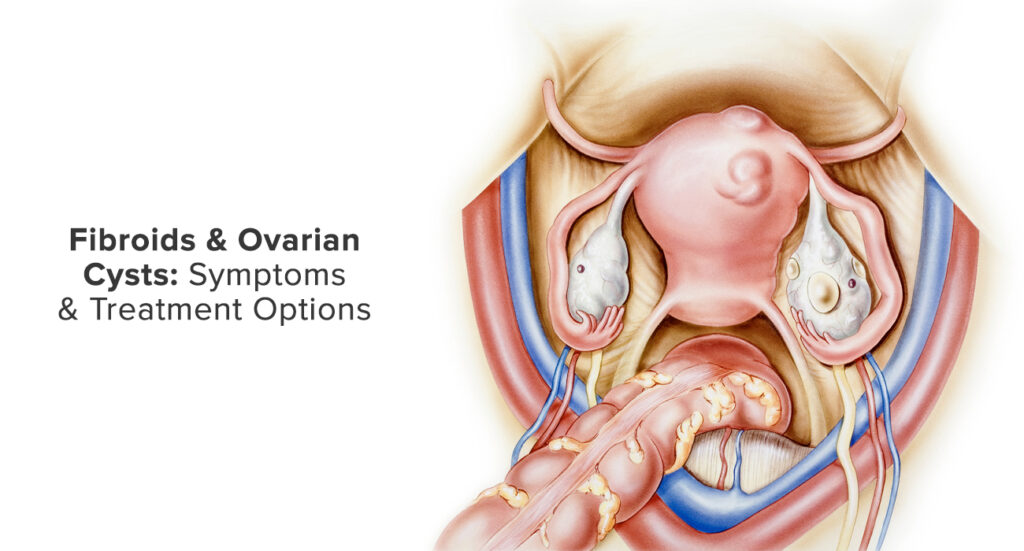
- Are uterine and ovarian growths always dangerous?
No. Most cysts and lumps in the pelvis are entirely benign (non-cancerous). In fact, many ovarian cysts are a completely normal side effect of your monthly menstrual cycle and disappear on their own without treatment. However, some complex growths do need to be monitored or surgically removed.
- What should I know about Ovarian Cysts?
Ovarian cysts are sacs—ranging from tiny fluid pockets to larger masses—that grow on or inside an ovary.
- Functional cysts are the most common; they happen when a normal monthly egg follicle fails to release properly or seals up after ovulation. They typically vanish within 2 to 3 cycles.
- Other types include dermoid cysts (which can contain tissue like hair or teeth), fluid-filled cystadenomas, and blood-filled endometriomas.
- While most cause no symptoms, very large cysts can cause pelvic pressure or bloating.
Note: Sudden, excruciating pain can indicate a medical emergency like a ruptured cyst or ovarian torsion (a twisted ovary).
- Can you get cysts inside the uterus?
True fluid-filled cysts are rare inside the uterus. Instead, the uterus tends to develop solid tissue growths and lumps, such as:
- Uterine Fibroids: Benign muscle tumors that can cause heavy bleeding, pelvic pressure, and backaches.
- Polyps: Small pieces of overgrown uterine lining that project into the cavity and cause irregular spotting.
Adenomyosis: A condition where the uterine lining grows directly into the muscular wall, causing a painful, swollen, and tender uterus.